
Decisions That Define You
By: Ron Patulski
Share Via:
Most outcomes aren’t shaped by strategy.
They’re shaped by the state you’re in when you decide.
Most people don’t struggle because they lack effort, intelligence, or ambition.
They struggle because they’re making important decisions while emotionally tilted.
Long before strategy comes into play, something quieter and more powerful is shaping results.
Your outcomes are determined by the state you’re in when decisions are made.
In today’s environment, constant information, business pressure, financial uncertainty, and rapid technological change keep many people operating in a near-continuous state of tension.
Fear is part of being human.
The real cost shows up when fear quietly becomes the decision-maker and goes unnoticed.
The Two Internal Strategies We All Run
Every day, often unconsciously, we operate from one of two internal “software strategies”:
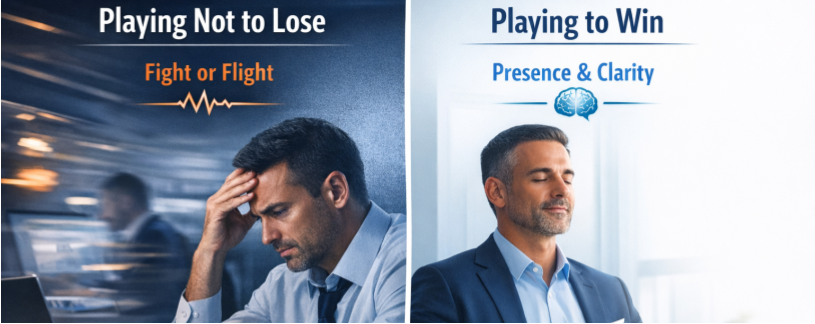
Playing Not to Lose
Or
Playing to Win
Both involve action.
Both can look responsible on the surface.
But they activate two very different nervous systems, which dramatically impact clarity, communication, and results.
Playing Not to Lose: The Protection State
Playing not to lose is fear-based and future-focused. It’s driven by the anticipation of loss, embarrassment, or uncertainty.
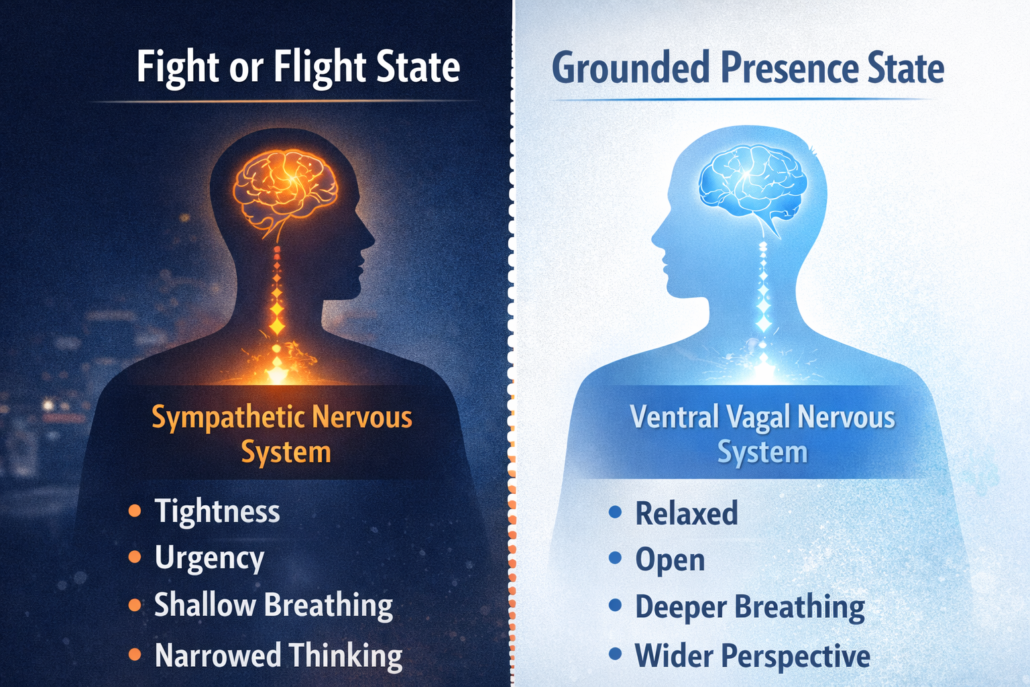
This strategy activates the sympathetic nervous system, commonly referred to as fight or flight.
When this system is dominant:
- The body tightens
- Breathing becomes shallow
- Thinking narrows
- Urgency and pressure increase
- Decisions prioritize short-term safety over long-term alignment
Even when the threat is imagined or future-based, the body responds as if it’s real.
That’s why playing not to lose often feels heavy, pressured, and exhausting. It’s not just a mindset focus issue. It’s biology doing exactly what it was designed to do.
Playing to Win: The Presence State
Playing to win operates from a different internal system.
This strategy accesses the ventral vagal nervous system, which supports calm, connection, creativity, and clear thinking.
When this system is available:
- The body feels grounded and open
- Breathing deepens naturally
- Perspective widens
- Decisions align with longer-term outcomes
- Possibility feels available again
Playing to win is not reckless optimism.
It’s a regulated presence.
State Is the Missing Variable in Performance
Your state is your inner condition-mental, emotional, and physical-at the moment a decision is made.
Most people try to change outcomes without ever checking state.
That’s why effort alone eventually leads to burnout, miscommunication, and stalled growth.
When you’re emotionally tilted, even the best strategy underperforms.
Awareness Is the Tool for Lasting Transformation
Here’s where real leverage begins.
You don’t think your way from playing not to lose into playing to win.
You notice your way there.
Pressure, tightness in the chest or stomach, racing thoughts, urgency, over-control – these aren’t failures. They’re signals. They tell you which system is running.
Awareness creates a pause.
The pause creates choice.
Choice allows state to shift.
This is the tool.
How to Shift State in Real Time
When you notice you’re emotionally tilted, you don’t need a complex protocol. You need an interrupt.
Simple actions that help shift from sympathetic activation back toward ventral vagal presence include:
- Breathing
Slow, intentional breathing with a longer exhale than inhale signals safety to the nervous system.
- Pausing before responding
Even saying, “Let me think about that for a moment,” interrupts reactivity.
- Physical grounding
Sitting back, dropping your shoulders, or feeling your feet on the floor brings the body out of protection.
- Naming the state
Silently noticing, “I feel pressure right now,” often reduces its grip.
The goal isn’t to eliminate fear.
It’s to prevent fear from unconsciously running decisions.
A Simple Framework You Can Use Daily
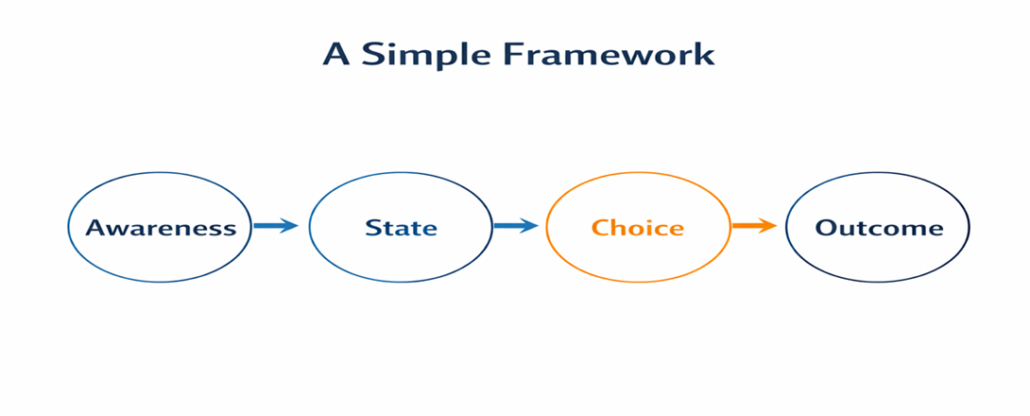
Awareness → State → Choice → Outcome
Awareness: What state am I in right now?
State: Am I operating from pressure or presence?
Choice: Am I responding consciously or reacting automatically?
Outcome: Results follow state and choice, not intention.
Where This Shows Up Most Often
- Client conversations
Over-talking to avoid discomfort vs. grounded clarity and silence
- Financial decisions
Reactive protection vs. intentional, values-aligned evaluation and strategy
- Boundaries
Saying yes from fear vs. saying no from self-trust
- Leadership
Control and urgency vs. calm direction and enrollment
The Quiet Truth
Most of life isn’t shaped by dramatic moments.
It’s shaped by small decisions made quietly every day:
How you speak.
When you pause.
What you avoid.
What you face.
Those decisions don’t just shape outcomes.
They shape who you become.
Where might you be playing not to lose without realizing it?
And what becomes possible when awareness allows you to shift state and choose to play to win?
If you’re interested in discovering how our methodologies and coaching help leaders, business owners, and teams shift state, make clearer decisions, and create different outcomes, we invite you to take the next step.
Answer a few short questions to schedule a consultation using this LINK and explore whether this work is right for you.

In 2011, after coaching an Executive at KW/MAPS Coaching, a division of Keller Williams Realty International, Ron was offered an opportunity to move to Austin, Texas and be an integral part of growing KW/MAPS Coaching. He started as V.P of Operations for MAPS Coaching, moved on to the position of V.P of MAPS Coaching and was instrumental in the development of MAPS Transformational Coaching, hiring and training coaches and ultimately serving as the Director of the division. During this time, he played an integral part to grow the client-coaching roster by 7x it’s original size, hired and developed 100’s of talented business coaches, and in the process, developed an amazing community of coaches and clients.


